Loyalists or Turncoats? Pioneers in Canada:
John Savage & Ann Pratt
 |
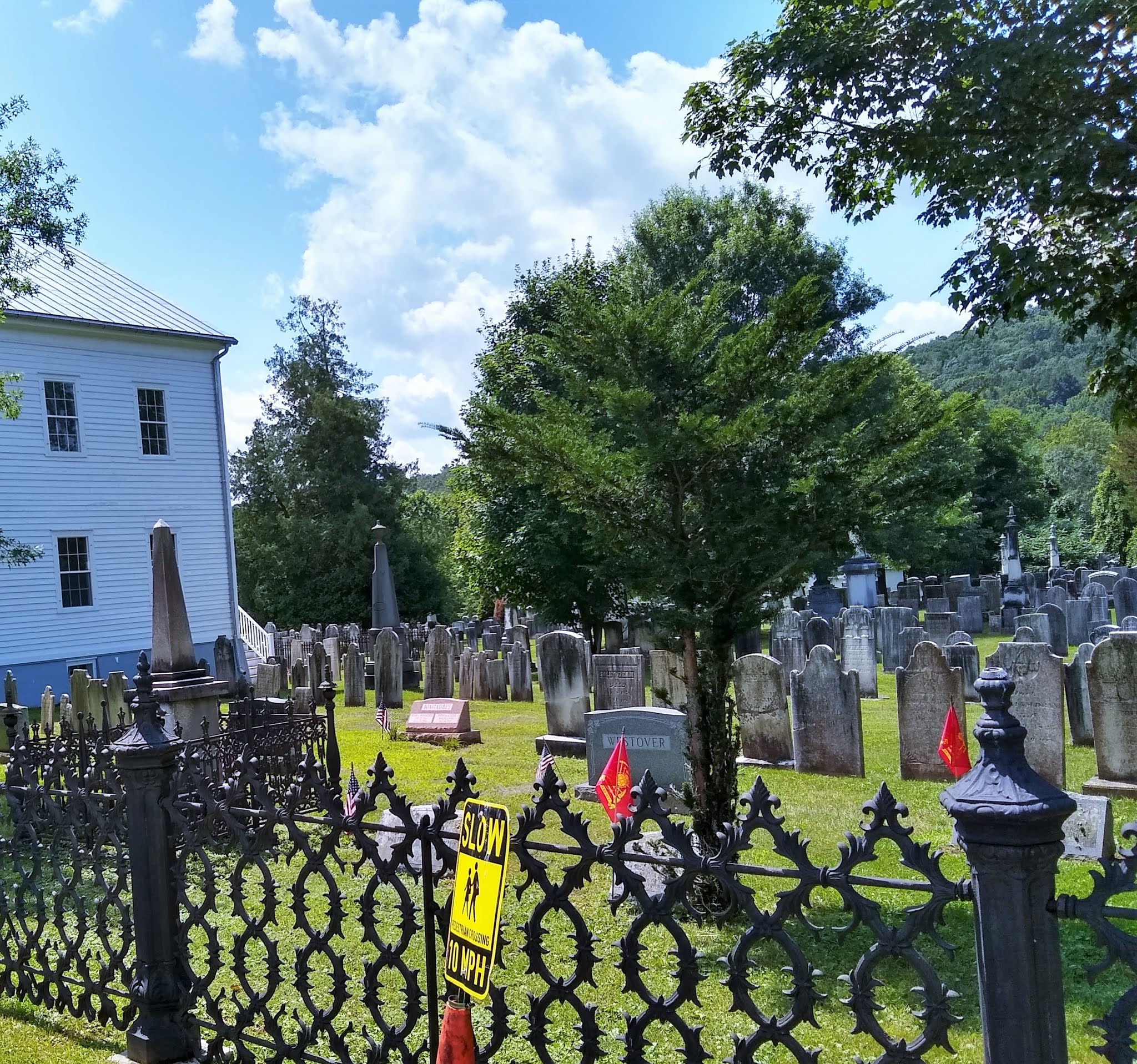
| John Johnson at his 5th gr-grandparents' gravestones, Bromont, Quebec |
John Savage: Tory, Land Developer, Militia Officer, and JP; Canada’s Paul Bunyan
John Savage was born abt 1740 in Ireland;
He married Ann Pratt, probably in Spencertown, N.Y. He died 27 Sept. 1826 in West Shefford (Bromont), Lower Canada, and was buried there two days later.
His wife Ann Pratt, daughter of Elisha Pratt and Ann Porter. She was born abt 1740 in New London, CT, USA, lived in Spencertown, NY and died Jun 1822 in Shefford, Quebec, Canada.
Both John Savage and his wife are buried in Bromont, Quebec, Canada
Their seven children:
- John Savage Jr 1770–1858,
- Abraham Savage 1770–?,
- Lydia Savage 1772–1852 (ancestor)
- Anna Savage 1774–1841,
- Rhoda Savage 1776–1845,
- Mary Savage ?
- Olive Savage 1786–1820,
- Joseph Plumer Savage 1794–1868
Portion of article below by Marie-Paule R. LaBrèque
"Before the American revolution the Savages owned land at Spencertown, where they had become quite influential.In 1775 John Savage refused command of the local company of the Continental Army, despite pressure from fellow citizens and two of his brothers-in-law.
As a result, he was considered to be an enemy, was ordered to put up a guarantee, and then was imprisoned.
Being daring and resourceful, he succeeded in escaping after several attempts and reached New York, where in 1776 he obtained a commission as a lieutenant in the Loyal Rangers.
He was captured again, narrowly missed being hanged, and was incarcerated for several months. After being freed, he served in the British army as a spy during the summer of 1782.
His zeal in the missions he carried out in the states of New York and Vermont earned him the highest praise.
However, republican hostility forced him to secure his family’s safety. Bearing a safe conduct, Savage and his family, with his brother James, left Crown Point, N.Y., and sought refuge in the province of Quebec in October 1783. Savage applied for lands east of Lake Champlain.
The Allen brothers, who commanded the Green Mountain Boys, were then trying to attract loyalists to Vermont, claiming that in so doing they were promoting the annexation of Vermont to Quebec.
Savage had served as an intermediary between the Allens and the military authorities in Quebec, and he supported this plan with the assent of some senior officers, despite the opposition of Governor Frederick Haldimand, who did not favour settlement near the American border.
In 1784 and for some years thereafter, Savage was living at Alburgh, south of the border, on what had been the seigneury of Foucault. The Allens, however, became supporters of Congress, and tried to make him take the oath of allegiance in 1791. Along with a number of other loyalists, he was forced to move to Caldwell’s Manor, a property in Lower Canada belonging to Henry Caldwell.
On 16 July 1792 Savage petitioned for the grant of Shefford Township. Like most of those signing petitions, he completed the many formalities at great expense: securing permission for a survey, drawing up a list of associates, taking various steps with the commissioners, as well as making several trips to Quebec, Chambly, and Missisquoi Bay.
Once he had taken the oath of allegiance in 1792, he busied himself opening up roads and completing the survey of the township, always at his own expense and even though he had no title to the land.
His family had to make do with a log cabin, and in the first winter he lost nearly all his livestock.
Quarrels between Governor Robert Prescott and the Executive Council were to paralyse land granting for some years. Tired of parading his service record and demanding fair compensation for his losses during the American revolution, he joined other dissatisfied people, among them Samuel Willard, in sending an agent to London to plead their cause.
In February 1800 Samuel Gale presented a report on their behalf, which caused some commotion in high places at Quebec. On 10 Feb. 1801 the letters patent for Shefford Township were formally granted; Savage and his 38 associates, a group including his son John and three of his sons-in-law, were then able to divide up about 34,000 acres.
To ensure financing for his undertaking Savage had engaged in real estate transactions even before the official grant was made, and he continued to make deals afterwards.
In 1805 Savage received a captain’s commission in the 2nd battalion of the Eastern Townships Militia.
The following year he obtained a commission as justice of the peace for the district of Montreal, which was renewed in 1810 and 1821. His home was long the scene of the principal events in the township; even religious services were held there. Anglican minister Charles James Stewart came to Shefford in 1808 and met Savage and his family.
Later he never failed to visit him when making pastoral rounds, and he held Savage in high esteem.
Despite his 72 years Savage wanted to play a part in the War of 1812. When on 10 Jan. 1813 Lieutenant-Colonel Sir John Johnson created the Frontier Light Infantry, Savage obtained a captain’s commission in the regiment.
On 13 August the Frontier Light Infantry was attached to the Voltigeurs Canadiens, under Charles-Michel d’Irumberry de Salaberry; it formed the 9th and 10th companies in that regiment at the end of the war.
By then, Shefford Township had a population of about 500. There were still no roads, despite efforts by Savage, who had cleared the first path from Missisquoi Bay in 1792.
In 1799 he turned his attention to the construction of a road to Montreal through Dorchester (Saint-Jean-sur-Richelieu) or the seigneury of Saint-Hyacinthe. Government grants would allow the construction of real roads, which Savage supervised, around 1816.
The establishing of regular religious services and the building of a church meant a great deal to Savage.
Early in 1818 he told Stewart of his plan, and on 14 Oct. 1819 he gave him four acres near his home for a church, as well as 800 acres worth £200.
Savage, who by then was 80, supervised the construction of the church in the summer of 1820, and he supplemented with his own money the small grant from the Anglican diocese. Perhaps he was too generous, since on 20 March 1824 he was taken to court by Saint-Hyacinthe merchant Joseph Cartier, who as his supplier since 1801 was claiming £42 from him. Savage could only give him two heifers in payment, and on 4 July 1825 two of his lots were seized by the sheriff and sold.
Like a true patriarch John Savage passed away in the midst of his family, a son and five daughters, their spouses, and 47 grandchildren all born in Shefford Township.
Savage had identified himself with this corner of the country which he had made his own by enterprise and perseverance. He had never swerved from his path, and his name remains associated with a lasting work."
FROM: -Marie-Paule R. LaBrèque - © 1987–2019 University of Toronto/Université Laval
Marie-Paule R. LaBrèque, “SAVAGE, JOHN,” in Dictionary of Canadian Biography, vol. 6, University of Toronto/Université Laval, 2003–, accessed March 22, 2019, http://www.biographi.ca/en/bio/savage_john_6E.html. Permalink: http://www.biographi.ca/en/bio/savage_john_6E.html
Author:Marie-Paule R. LaBrèque
Title:SAVAGE, JOHN
Publication:Dictionary of Canadian Biography, vol. 6
Publisher:University of Toronto/Université Laval
Year of publication:1987
Access Date:March 22, 2019
 |
| Location of Concord in Columbia Co, NY, USA |
 |
| 1790 John Savage Claim (front) |
 |
| 1790 John Savage Claim (back) | | |
|
 |
| Death Record, John Savage |
 |
| Home of John Savage in Bromont, Quebec, Canada | | | |